Pension Commutation: Take the Lump Sum or Keep Your Full Pension?
Commutation is probably the one retirement question that Armed Forces officers have asked me more often than almost anything else over the years.“Sir, should I commute 50%?” “Will I lose money?” “Why does the government recover so much more than it pays?” And, of course, “What if I invest the amount and the markets fall?”Funny thing is, I kind of started this trend myself. Nine years ago, when nobody ever asked this question and simply signed on the dotted lines on pension documents as put up by their Clerk, I wrote an article on pension commutation. And suddenly, it became the hottest topic in messes, bar stools, units, parties, and WhatsApp groups. I even got asked about it in the Q&A session of my lecture at DSSC, Wellington - by a Major of 6 years of service, no less! The fascination is understandable. We are talking about a decision involving ...

Pension, ECHS and Retirement Corpus
Whenever I discuss retirement planning with Armed Forces officers, one response comes up quite often: "Sir, pension is there, ECHS is there, and I will get a reasonable retirement corpus. So, what is there to worry about?"Frankly, there is considerable merit in that thinking. Our officers retire with financial advantages that a large majority of civilian retirees would be happy to have. The difficulty starts when these advantages are taken to mean that retirement planning is largely unnecessary. Having adequate financial resources and knowing how to use them are two quite different things. Your Pension Is a Bigger Asset Than You Realise For most superannuating officers, pension is sufficient to take care of the normal monthly expenses of a couple. It also enjoys a significant advantage over most other retirement income sources: Dearness Relief (DR, the retirement equivalent of DA), which is periodically revised and provides some protection against inflation ...

Your Next Mission After Uniform Deserves a Plan
Most Armed Forces Officers Do Not Retire Weak That is the first thing to understand. An officer retiring from service normally has a pension, ECHS, discipline, experience, social standing and, in many cases, a retirement corpus in the broad range of Rs 1.5-2.5 crore. Depending on rank, savings, investments, property and retirement benefits, it may be higher. There may also be additional amounts later through pay commission arrears and related adjustments. So, the problem is not that the officer has nothing. The problem is whether what he has is put to proper use. Why Retirement Planning Gets Delayed Over the years, I have seen one pattern repeatedly. Officers do not ignore retirement planning because they are careless. They ignore it because they are busy, confident and used to structure. Service life keeps them occupied. There is always one more posting, one more responsibility, one more family issue, one more course, ...

Gift to a loved one? How about a Mutual Fund SIP?
Divesh Kumar has recently retired as a contended man. He hasfulfilled his duties as a devoted father, caring son and loving husband all his life. He now wants to gift something long lasting for his two lovely grandchildren which he and his wife fondly dote on. They both decided to contribute for higher studies for them by contributing some money every month. Their first impulse was to save in a bank Recurring Deposit (RD) but wanted their decision to be validated by us. We heard them out and asked them, “Have you thought of mutual funds for this purpose?” They never had thought so. We explained to them that they had a long time frame for their gift. The gift should actually work for the recipients to create value as they have planned and not be lost to inflation and taxes. In case of any emergent requirement some time later, ...
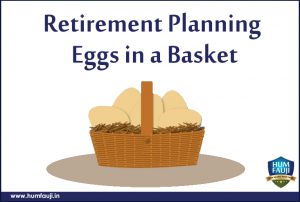
Retirement Planning Eggs in a Basket
One of the most common mistakes done by most of the retired or recently retired persons is to put majority of their money in same or similar investment avenues, like bank FDs, real-estate, Gold, Post Office instruments, etc. All eggs in one basket is never a good mantra to follow whether it is physical eggs or retirement nest-egg! The article below deals with this aspect as also the eroding effect that inflation has on the retirement corpus. A 4-step strategy to be followed is also suggested for living a golden retired life. The basic issue is to plan well, execute well, monitor well and thus, LIVE WELL. (please enable ‘Display Images Below’ in your browser to see the newspaper clipping) Visit our Blog, https://humfauji.in/blog or facebook page http://www.facebook.com/HumFaujiInitiatives or follow us on Twitter https://twitter.com/#!/humfauji to get latest insight on matters financial ...

Retire to live comfortably
Government guaranteed pension, inflation-beating returns from safe investment schemes, low rate of inflation and the comfort of a joint family - all these four pillars on which retirement planning rested earlier, have disappeared. Recently retired or tomorrow’s retirees will need to balance high expenses with uncertain returns on their invested capital, longer lifespan with ever looming dangers of outliving their accumulated retirement corpus, and an urge to hang up their boots early. And all this, without wanting to compromise on their lifestyle at any stage – while working or when retired. The actual big challenge for retirees comes from an enemy which is not easily recognized - inflation. Just as compounding works to grow your corpus, inflation eats away at its value without your knowledge. A retirement corpus of Rs 1 crore may seem like a lot of money today but over 30 years, an inflation of 8% can reduce ...
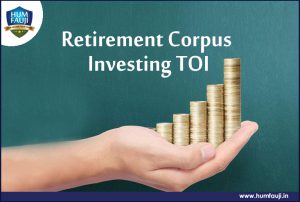
Retirement Corpus Investing TOI
My article in Times of India today (01 July 2014) on Retirement Investing Please find attached below my article in the Times of India of today (01 July 2014 – financial planning page). It is regarding how most of the retired or retiring people invest their retirement corpus considering ‘safety of capital’ as the prime criterion, only to discover few years down the line that their capital has lost its purchasing power due to the twin onslaught of inflation and tax. A carefully made portfolio, which finely balances risk, returns and balance liabilities, while ensuring that the standard of living does not go down throughout the lifetime of the last surviving spouse, is the best way to go about such an investment. Also, such investments cannot be a fire-and-forget solution – they need to be invested, monitored and re-balanced if required at regular intervals. (please enable your 'view images' in ...
Revisiting Tax-free Bonds: Ideal Instrument for Retired and Retiring Persons
I had written about Tax Free bonds a month back on my blog (read: https://humfauji.in/blog). There were many queries on the same. Hence, I felt the need to clarify some more on these tax-free bonds. In the meantime, the current crop of tax-free bonds on the block have improved in returns over the ones available earlier a month back, thus making them even better in their offering. The additional points that make these bonds attractive for the retiring and the retired persons are as follows:- The returns are even better now. Consider the table below for the Power Finance Corporation (PFC) bonds: Individuals Retail (UPTO Rs 10 LACS) TAX FREE Coupon TAX BRACKET 10.30% TAX BRACKET 20.60% TAX BRACKET 30.90% 10 Years 8.43% 9.40% 10.62% 12.20% 15 Years 8.79% 9.80% 11.07% 12.72% 20 years 8.92% 9.94% 11.23% 12.91% Individuals HNI (More than 10 LACS) TAX FREE Coupon TAX BRACKET 10.30% ...
Investments for the recently Retired in India
Retirement marks the beginning of a new phase in an individual's life. It's a transition from a lifetime of work to a time when one can relax, spend time with the family and pursue other interests, which somehow take a backseat when on a regular job. Not only this, retirement also marks a transition in one's finances. With a regular stream of income no longer available, the savings made over one's working years now have to provide for all his needs. Even if one decides to go in for a second career (eg, in case of Defence Officers who retire early or others who may find another job in private sector due to skills acquired during working life), it will be for a limited period of time till, say, 60-65 years of age. Taking a life-expectancy of 85 years, there are still 20-25 years of non-earning life to be lived, ...
IS 100% SAFE RETURNS FOR RETIRED PEOPLE ACTUALLY AN INVESTMENT MYTH?
There are any number of websites, articles and experts extolling the virtues of realigning your asset allocation to ‘safer’ avenues as one inches towards his retirement. Some go to the extent of advocating a 100% debt portfolio the day one retires. Many arguments are advanced in favour of this shift – emotional ones (‘need to protect one’s life-long savings’), pseudo-logical ones (‘cannot afford to lose even a single paisa now as the earning are much reduced while expenses only rise’) and even medical reasons (‘cannot afford to have another stress-point in old age’). But the truth actually lies far away from these appeals. Let us look at the arguments that dictate that we should actually move towards lower safety instruments to ensure that we remain financially safe!! The biggest threat to the retirement corpus, painstakingly built up over the years, is inflation and income tax. Inflation eats into the purchasing ...