
One Wrong Click Can Cost You Lakhs
It usually starts with something that looks completely normal.
‘Your KYC has expired.’
‘Your parcel couldn’t be delivered.’
‘Your bank account will be blocked unless you verify your details.’
The message looks genuine. The logo seems familiar. Without thinking twice, you click.
That’s exactly what cybercriminals are waiting for.

Today’s fraudsters don’t just hack devices – they hack human emotions. By creating urgency, fear, or excitement, they trick people into revealing sensitive information or downloading malicious apps.
The threat is real. According to the Ministry of Home Affairs’ Indian Cyber Crime Coordination Centre (I4C), Indians reported over ₹22,800 crore in cyber fraud losses during 2024, with digital arrest scams, phishing, fake investment schemes, and UPI frauds among the fastest – growing threats. It would have only got worse in the past 1½ years.
Before you click, pause and ask yourself:
- ✔ Is the sender genuine?
- ✔ Is someone asking for my OTP, UPI PIN, CVV, or password?
- ✔ Is this message creating unnecessary urgency while it does not seem to be anything urgent to you?
- ✔ Is the investment promising ‘guaranteed’ returns?
If the answer to any of these is Yes, stop immediately.
Your wealth takes years to build, but a scammer needs only a few seconds to steal it.
Think before you click. Because one careless click can cost you far more than money – it can cost you your peace of mind.
(Contributed by Abhilash Rana, Relationship Manager, HNI Desk, Hum Fauji Initiatives)
👉 Stay alert. Stay secure. Protect your hard – earned wealth.
How Goal – Based Investing Prevents Emotional Portfolio Changes
Every market cycle brings two powerful emotions – fear when markets fall and greed when markets rise – in fact, the stock markets are called the ‘Fear-and-Greed’ cycle really! Unfortunately, many investors let these emotions drive their decisions, buying when optimism is high and selling when fear takes over.
Now, take a look at the chart below. It tells a story that every investor should remember.
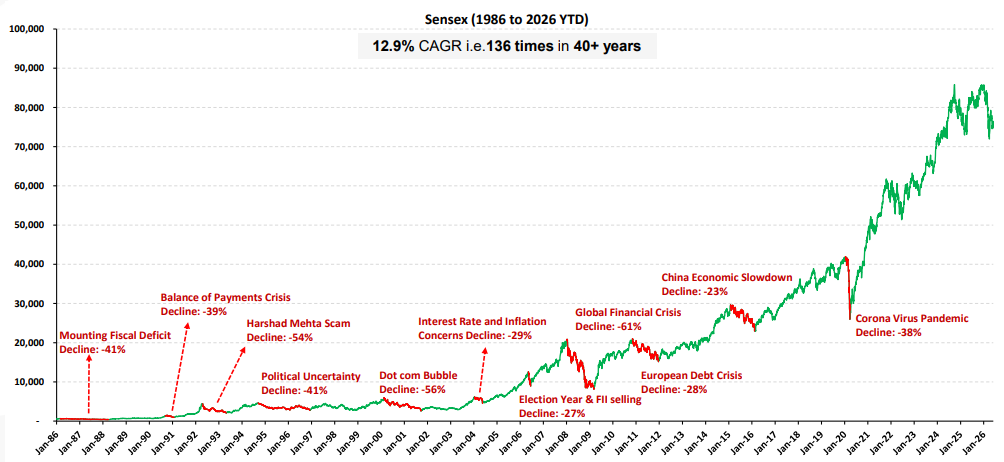
Source: Funds India, Data as of 31 May 2026
Despite fiscal stress, scams, global crises, inflation shocks, and pandemics, Indian equities have continued compounding wealth over decades.
Over the last 40 years, Indian equity markets have weathered almost every imaginable challenge – economic crises, scams, political uncertainty, the Global Financial Crisis, COVID – 19, inflation shocks, and geopolitical tensions. At every stage, it felt like the market would never recover.
Yet despite these setbacks, the Sensex has delivered a Compounded Annual Growth Rate (CAGR) of around 12.9%, growing nearly 136 times since 1986.
Every sharp fall on this chart represents a moment when investors questioned whether they should stay invested. Every recovery reminds us why patient investors are often rewarded.
The chart reinforces an important lesson: markets react to events, but wealth is created by staying invested through them.
When your investments are linked to meaningful goals – your child’s education, retirement, or financial independence – temporary market declines become less frightening. Instead of reacting to headlines, ask yourself one simple question: ‘Am I still on track to achieve my goal?’
Short – term volatility is inevitable, but long-term discipline has historically rewarded patient investors. Every correction in this chart once felt like the end of the market – but every recovery proved that patience often outlasts panic.
(Contributed by Pregya Bansal, Relationship Manager, HNI Desk, Hum Fauji Initiatives)
👉 Don’t let emotions write your investment story. Let Hum Fauji Initiatives help you stay focused on what truly matters – your financial goals.
Get an expert opinion before making your next investment.
Your Portfolio Can Recover. Will Your Confidence?

When markets fall, investors immediately notice the numbers.
‘My portfolio is down 8%.’
‘I’ve lost ₹2 lakh.’
But there’s another loss that rarely appears in the portfolio statement and it’s often far more expensive.
The loss of confidence.
It’s confidence that makes investors stop their SIPs, redeem investments during a correction, or wait endlessly for the ‘perfect time’ to invest again. Ironically, these decisions often lock in losses, while the market quietly begins its recovery.
History reminds us that market corrections are not exceptions – they are part of investing. Since 2000, Indian equity markets have experienced multiple corrections of over 20%, triggered by events such as the Dot com crash, the Global Financial Crisis, COVI 19, and inflation-led sell-offs. Yet, each cycle eventually gave way to recovery and new highs.
This is why diversification and goal-based investing matter. A well-diversified portfolio is designed to absorb volatility, while clear financial goals help you stay focused when emotions tempt you to change course.
The next time markets fall, don’t ask, ‘Should I stop investing?’ Ask, ‘Has my financial goal changed?’
If the answer is No, your strategy may not need to change either.
Markets don’t test your ability to earn returns – they test your ability to stay invested long enough to receive those returns.
(Contributed by Ankit Kumar, Relationship Manager, Team Prithvi, Hum Fauji Initiatives)
A strong plan keeps you invested even when markets don’t.
Build yours with Hum Fauji Initiatives.
What did our clients ask us in the last 7 days
Question – I have recently sold a property and I’m unsure whether I’ll buy another property. What should I do with the sale proceeds in the meantime, and where should I invest the money?
Our Reply –
One of the biggest mistakes people make after selling a property is rushing into another purchase just to save capital gains tax, however small, and the earlier the better.
Remember, a tax-saving decision should never become a wealth-destroying decision.
If you haven’t found the right property yet, don’t feel pressured to invest immediately. The Income Tax Act provides options that allow you to save tax while giving yourself time to make the right financial decision.

Here’s what you should know:
✅ Planning to buy another residential property?
If you intend to claim exemption under Section 54 or Section 54F, but haven’t finalized a property before your Income Tax Return (ITR) due date, you can deposit the unutilized capital gains into a Capital Gains Account Scheme (CGAS) with an authorised bank. This helps preserve your tax exemption while you continue your property search.
✅ Not planning to buy another property?
You may consider investing up to ₹50 lakh in Section 54EC Capital Gain Bonds within 6 months of the sale, subject to the prescribed conditions, to claim tax benefits.
❌ Miss the timelines or use the money elsewhere?
Your capital gains may become taxable as per the applicable provisions.
The right question isn’t, ‘How do I save tax?’ It’s, ‘What’s the smartest use of my money?’ The two aren’t always the same.
For years, our investors have been receiving an unbiased advice from us in such circumstances wherein we lay down the options available to them on sale of properties and a comparison chart of which option would be the best one for them, supported with tax and returns calculations.
This enables them to take decisions based on logic and calculations, rather than a fuzzy application of emotional decisions.
(Contributed by Team Prithvi, Hum Fauji Initiatives)
👉 Save tax smartly – not hurriedly. Connect with Hum Fauji Initiatives.
The smartest investment begins with the right advice.
Speak to an expert before you reinvest.