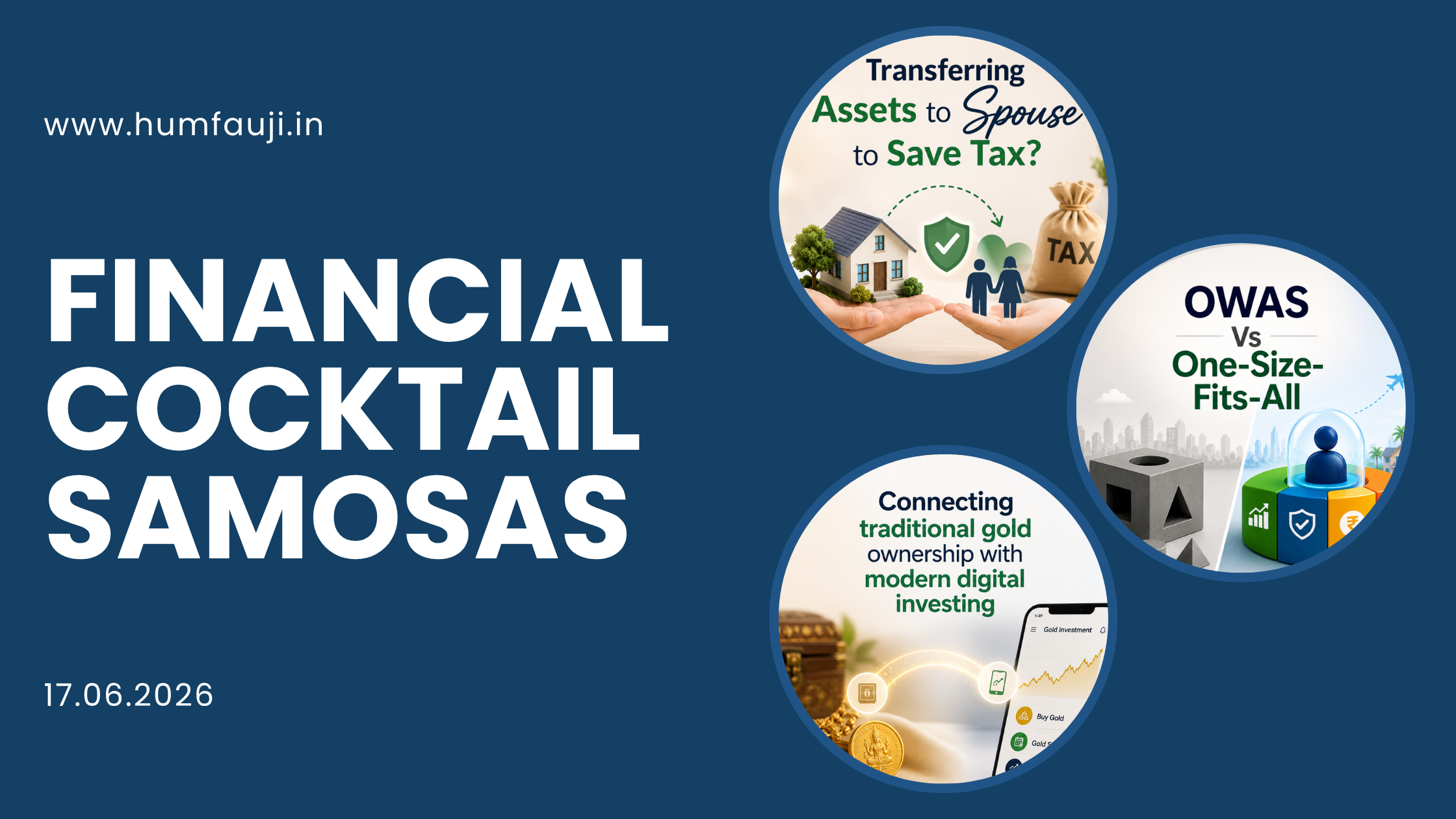
Transferring Assets to Spouse to Save Tax? Read This First
Many people think they’ve found a smart tax-saving trick: transfer money or investments to their spouse and let the income be taxed in the spouse’s lower tax bracket. Sounds simple, right?

Not quite.
The Income Tax Act has a provision called the Clubbing of Income Rules (Section 64 of the Income Tax Act), specifically designed to prevent this kind of tax avoidance.
Here’s How It Works
Imagine Raj gifts ₹10 lakh to his wife, Priya. Priya invests the money in a fixed deposit that earns ₹70,000 annually as interest.
Most people would assume that since the FD is in Priya’s name, she will pay tax on the interest.
However, the Income Tax Department sees it differently.
Since the original money came from Raj without any consideration, the ₹70,000 interest will be added to Raj’s taxable income, not Priya’s. This is known as clubbing of income.
Does That Mean Gifting Is Useless? Not at all.
The gift itself is completely tax-free between spouses. The catch lies in the income generated from the gifted asset.
Interestingly, if Priya reinvests the ₹70,000 interest and earns additional income from that reinvestment, the subsequent income is generally taxable in her hands, not Raj’s.
When Clubbing Rules Don’t Apply between Spouses
The clubbing provisions may not apply if:
- ✔ The spouse invests from their own income or savings
- ✔ The asset is purchased by paying fair market value
- ✔ Income arises from reinvestment of previously earned income
Changing the ownership of an investment does not always change the tax liability. The Income Tax Department looks beyond the name on the asset and focuses on the source of the funds.
Before implementing any family tax-planning strategy, understand the clubbing provisions carefully. What appears to be a tax-saving move may provide no tax benefit at all but rather a tax return filing headache where the interest is shown in one spouse’s AIS but the tax payment is not due there but in the other spouse’s tax account.
(Contributed by Abhilash Rana, Relationship Manager, HNI Desk, Hum Fauji Initiatives)
 Smart tax planning is about understanding the rules before making financial decisions. We have now started Income Tax filing services.
Reach out for assistance and stay updated on important tax developments.
OWAS Vs One-Size-Fits-All: Why NRIs Need Custom Portfolio Strategies NRI investments
A 30-year-old software engineer in Dubai, a 45-year-old executive in Singapore, and a retired professional in the UK may all be NRIs. But should they have the same investment portfolio?
Absolutely not.

Yet many NRIs continue to receive similar recommendations – mutual funds, fixed deposits, or real estate – without considering their unique financial circumstances. The reality is that every NRI faces different challenges, opportunities, and long-term objectives.
Factors such as country of residence, tax regulations, currency exposure, family responsibilities, future relocation plans, and risk appetite all play a crucial role in shaping an effective investment strategy. A portfolio suitable for someone building wealth may be completely unsuitable for someone seeking retirement income or capital preservation.
This is where personalized portfolio construction becomes important.
In Hum Fauji’s One World Advisory Services (OWAS), portfolio recommendations are built around the investor – not around products. Every portfolio is designed after considering financial goals, investment horizon, risk profile, and global financial considerations.
Broadly, investors may choose from:
- • Conservative Portfolio – Focused on capital preservation and stability through diversified, lower-risk investments.
- • Balanced Portfolio – Designed for investors seeking a mix of growth and stability over the long term.
- • Aggressive Portfolio – Focused on higher growth potential through global opportunities and innovation-driven sectors.
What differentiates OWAS is its flat-fee advisory model, ensuring recommendations remain free from commissions and product-driven incentives. Investors retain complete control over their investments while benefiting from professional guidance and research-backed strategies.
No two NRIs have the same financial journey. Their investment strategy shouldn’t be identical either. The most effective portfolio is not the one that is popular – it is the one that aligns with your goals, responsibilities, and future aspirations.
And OWAS is open to all who stay outside India – your own family members, your relatives and friends, your everybody else’s friends, foreign nationals….anybody!
(Contributed by Ankit Kumar Singh, Relationship Manager, Team Prithvi, Hum Fauji Initiatives)
Your financial journey is unique. Your portfolio should be too.
Connect with us to explore a personalized investment approach.
Connecting traditional gold ownership with modern digital investing
Gold has always been a trusted investment for Indian households. With the rise of digital investing, EGRs are emerging as a modern and regulated way to invest in gold while still retaining the backing of physical gold.
An EGRs is a digital certificate representing physical gold stored in SEBI-approved vaults. These receipts are held in Demat form and traded on stock exchanges similar to shares. Investors can buy, sell, or even convert EGRs into physical gold when required.

Currently, buying or selling of EGRs on stock exchanges does not attract GST. GST is applicable only when investors opt for physical delivery of gold.
Profits earned from the sale of EGRs are taxable. If the investment is sold within 2 years, the gains are taxed according to the investor’s income tax slab. However, if held for more than 2 years, a long-term capital gains tax of 12.5% is applicable under current tax regulations.
Additionally, STT is generally not levied on EGR transactions. Since tax regulations may change over time, investors are advised to consult tax advisors or financial professionals before investing in EGRs.
EGRs mark a new chapter in India’s gold investment journey. As this evolving investment avenue grows over time, investors should focus on informed and balanced decision-making while understanding the opportunities and risks involved.
(Contributed by Pregya Bansal, Relationship Manager, HNI Desk 1, Hum Fauji Initiatives)
What did our clients ask us in the last 7 days
Question
My financial goal, originally planned for two years from now, has now been advanced to the next 2-4 months. Given the current market downturn, should I wait for a recovery or redeem my investments now?
Our Reply
This is a very relevant question, especially when unexpected life events shift our carefully planned financial timelines.
The key principle is simple – when a goal moves from two years away to just 2-4 months away, your focus should shift from wealth creation to capital protection. Markets recover eventually, but they do not always recover within our required timelines.

When your timeline suddenly shrinks:
- Prioritize certainty over recovery. If the money is required within the next few months, protecting the amount already accumulated is generally more important than hoping for a short-term market rebound.
- Avoid trying to predict the market. Market corrections can sometimes last longer than expected. Decisions based on future market movements are often speculative.
- Review alternative sources. If you have emergency funds, liquid investments, or access to a loan against your investments, these may help meet the requirement without disturbing long-term investments.
In simple terms:
- Goal within 2–4 months: Prioritize capital protection.
- Amount needed immediately: Consider redeeming, staggering withdrawals or looking at alternatives like loan against your investments.
- Amount not required now: Allow it to remain invested for future growth.
When the goal date moves closer, certainty becomes more valuable than chasing a market recovery. Remember: your goal timeline should drive your investment decision, not the market’s direction.
(Contributed by Team Prithvi, Hum Fauji Initiatives)
Connect with HFI for guidance on aligning your investments with your goals and timelines.