
Your Retirement Corpus Is Ready. But Is Your Cash Flow Ready?
For superannuating Armed Forces retirees or those who retire with a pension, retirement does not mean regular income stops. Pension, with Dearness Relief revisions, may meet much of a couple’s routine monthly spending. That changes the cash-flow question: not “How do I make my corpus pay my monthly bills?” since pension is there, but “What should my corpus do alongside my pension?”

During your working years, your salary provides a predictable monthly cash flow. In retirement, that regular income may reduce significantly, while expenses continue and inflation can make them rise over time.
Start by comparing monthly expenses with pension and other dependable income. Include help to children in education or marriage or settling down, travel, home maintenance and the larger costs that do not come every month. Dearness Relief helps, but it may not keep pace with every expense—especially costs like travel whose costs grow faster than DR. The difference between your expenses and reliable income is the cash-flow gap that your investments need to address.
If pension covers the essentials, the corpus need not be forced into a high monthly payout. It can fund larger or irregular needs, give the family flexibility and retain a growth component for later years. If there is a gap, plan withdrawals to meet it without taking unnecessary risk or drawing too heavily too early.
A sound retirement plan coordinates pension and investments. The aim is to have a good life today while keeping enough flexibility and resilience for the years ahead.
Your Pension Covers the Bills. But Is Your Retirement Corpus Ready for What’s Next? Find Out →
Market Up. Market Down. Your SIP Doesn’t Care. Should You?
Imagine this. The market falls 5%. Your portfolio turns red. News channels predict more pain, and your friend says, “Stop your SIPs. Wait for the market to settle.”
But while you’re waiting, thousands of investors continue investing every month.
Are they being careless—or following a plan?
The SIP Story
In September 2026, monthly SIP contributions in India touched a record ₹32,490 crore, surpassing August’s ₹32,297 crore, even as markets remained volatile.
The idea behind an SIP is simple: invest a fixed amount regularly, regardless of market levels. When prices fall, the same amount buys more units. When prices rise, it buys fewer.
Over time, this can help average your purchase cost. But remember, it does not guarantee profits or protect you from market losses.
What Does History Tell Us?
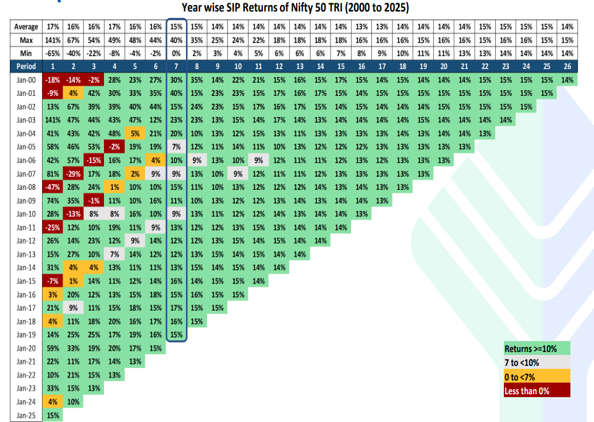
Source: Funds India
Historically, equity SIPs over seven years or longer have shown encouraging return patterns in the dataset above, with an average annualised return of approximately 15% over seven-year rolling periods. However, outcomes vary, and past performance does not guarantee future returns.
Should You Stop Your SIP Whenever Markets Fall?
Not at all. If your goals, time horizon and financial situation remain unchanged, continuing a suitable SIP can not only help maintain investment discipline but also benefit you in the long run due to buying the same mutual fund units at lower prices. However, if your income changes, you need the money soon, or your portfolio no longer matches your risk profile, a review may be necessary.
Remember: You don’t need to predict every market move to become a disciplined investor.
The market may test your patience. Your investment plan should guide your decisions—not your emotions.
Thinking of Pausing Your SIP After a Market Fall? Read This Before You Decide →
(Contributed by Pratyush Sharma, Relationship Manager, HNI Desk, Hum Fauji Initiatives)
LAMF: Liquidity Without Liquidation
Need funds urgently? Should you sell your investments or borrow against them?
When an unexpected expense arises, redeeming investments may seem like the easiest option. But what if you could access funds without selling your mutual fund units?
A Loan Against Mutual Funds (LAMF) allows eligible investors to pledge their mutual fund units as collateral and borrow against their value. This can help meet immediate financial needs while keeping investments in the market.

Consider this example: An Armed Forces officer needs ₹5 lakh for their child’s higher education fees. Instead of redeeming mutual funds earmarked for long-term goals, they could explore LAMF to arrange the funds while keeping those investments intact.
Why Consider LAMF?
- Preserve investments: Access liquidity without immediately redeeming pledged units.
- Potentially lower borrowing costs: Secured borrowing may cost less than an unsecured personal loan, depending on the lender and terms.
- Flexible access: Borrow within the approved limit and understand the repayment and interest conditions before proceeding.
- Retain growth potential: Your investments remain exposed to market movements and may gain or lose value.
What should you remember? LAMF is still a loan. Interest and repayment obligations apply, and falling market values may trigger additional collateral requirements or other lender actions. Borrowing is not always better than redeeming; compare the total cost, repayment capacity and investment horizon before deciding.
The takeaway: The goal is to meet immediate financial needs without unnecessarily disrupting long-term plans—but only when borrowing is suitable and affordable.
For more details, read here: Loan Against Mutual Funds
Need Money Urgently? Should You Sell Your Mutual Funds or Borrow Against Them? Find Out →
(Contributed by Ganga Kumari, Financial Planner, Advisory Desk, Hum Fauji Initiatives)
What Did Our Clients Ask Us in the Last 7 Days?
Question
My son is now a foreign citizen and holds an OCI card. I would like to understand what health and life insurance options are available to him in India. Can an OCI cardholder buy or continue an Indian health insurance policy and term life insurance? Are there any restrictions, additional documentation, medical tests, or differences in premiums?
Our Reply
Yes, OCI cardholders may be eligible to purchase or continue health and term life insurance policies in India, subject to the insurer’s eligibility criteria and underwriting guidelines.

- Health Insurance: Coverage is generally for treatment in India unless overseas coverage is specifically included. Eligibility depends on the insurer and country of residence.
- Term Life Insurance: Some Indian insurers accept applications from OCI cardholders. Eligibility and premiums depend on age, health, income, occupation, country of residence and sum assured.
- Documentation and Medical Tests: Insurers may require a foreign passport, OCI card, overseas address proof and income documents. Medical tests may be required depending on the applicant’s profile and coverage sought.
- Existing Policies: Any change in citizenship or residential status should be disclosed to the insurer. Written confirmation should be obtained regarding policy continuation, coverage, premium payments and claim conditions.
Recommendation: We suggest confirming the insurer’s specific eligibility criteria, documentation requirements, applicable premiums and coverage conditions based on your son’s country of residence and whether he needs a new policy or wishes to continue an existing one.
Your Child Holds an OCI Card. Can They Get Health and Life Insurance in India? Find Out →
(Contributed by Team Sukhoi, Hum Fauji Initiatives)