
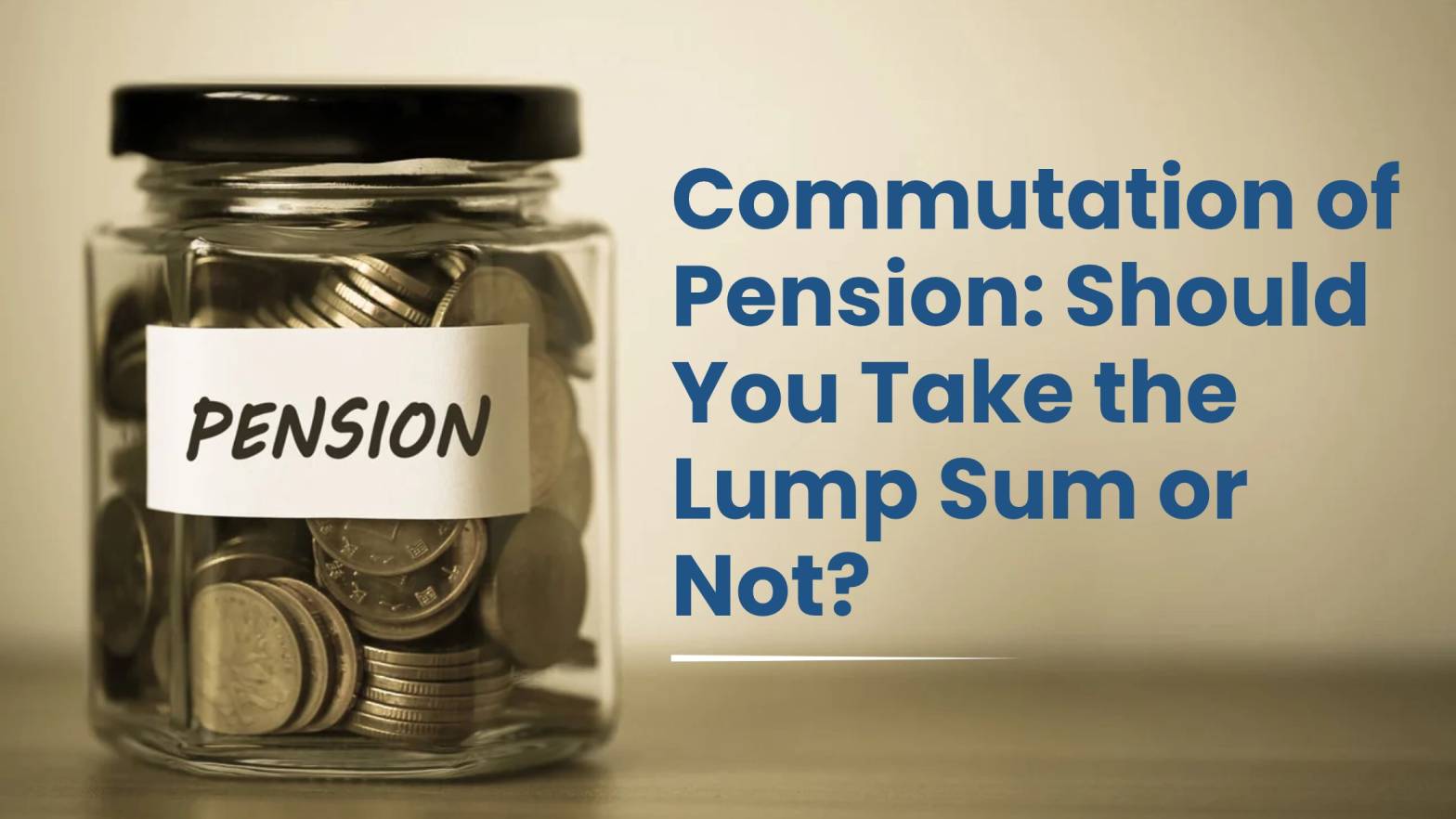
And suddenly, it became the hottest topic in messes, bar stools, units, parties, and WhatsApp groups.
I even got asked about it in the Q&A session of my lecture at DSSC, Wellington – by a Major of 6 years of service, no less!
The fascination is understandable. We are talking about a decision involving several lakhs of rupees, affecting the pension you receive for the next 15 years. But I have always maintained that the answer should depend on your financial circumstances, not on what your coursemate did.
First, Understand What You Are Actually Getting
An Armed Forces officer can commute up to 50% of basic pension, receiving a tax-free lump sum in exchange for a reduction in monthly basic pension for 15 years. At the end of that period, the commuted portion is restored.
Importantly, Dearness Relief (DR) is not commuted. It continues to be calculated on your original basic pension, including applicable revisions.
The lump sum depends on the basic pension, the percentage commuted and the government-prescribed factor for your age next birthday.
Let us take a realistic example.
An officer retires at 54 with a basic pension of Rs 1.5 lakh per month, excluding DR. His age next birthday is 55, for which the commutation factor, as per the Govt, is 8.627. If he commutes 50%, his calculation looks like this:
Illustrative Commutation Calculation
Officer retiring at age 54 • 50% commutation
| Particular | Amount |
|---|---|
| Basic monthly pension | Rs 1,50,000 |
| Monthly basic pension commuted | Rs 75,000 |
| Tax-free commutation amount received | Rs 77,64,300 |
| Monthly pension for the next 15 years | Rs 75,000 + full applicable DR |
| Gross amount paid back over 15 years | Rs 1,35,00,000 |
The first reaction is usually, “I received Rs 77.64 lakhs, but the government will deduct Rs 1.35 crore! What kind of deal is this?”
Fair question. But an incomplete calculation.
Start with clarity on Pension.
Request the Pre-Retirement Action Checklist
What Interest Is the Government Really Charging?
Think of commutation somewhat like taking an advance against next 15 years of pension. You receive the money today. In exchange, you pay back Rs 75,000 fixed monthly for the next 15 years.
When we calculate the financing cost using these monthly cashflows, the effective annual rate works out to approximately 8.18% before tax, which seems quite high.
However, there is a major advantage which officers frequently overlook.
Your normal pension is taxable (except a very few for whom it is tax exempt). Your commutation lump sum is completely tax-free.
Suppose the pension you surrender would otherwise have been taxed at an effective marginal rate of 25%, ignoring cess for simplicity. The Rs 75,000 gross monthly reduction then gets you only Rs 56,250 in hand in after-tax income. Using this lower monthly outflow against the same Rs 77.64 lakh received upfront, the effective annual financing cost becomes approximately 3.76%.
And if we include the normal 4% cess too on that 25% tax rate had you not commuted, the effective financing cost falls to approximately 3.56%.
These are illustrative calculations. Your actual tax saving will depend on your total taxable income, chosen tax regime and applicable tax rates over the 15 years.
THE KEY TAKEAWAY
Tax can substantially change the economics of commutation.
But the important point is that the apparent difference between Rs 77.64 lakh received and Rs 1.35 crore deducted does not tell the full story.
So, Does This Mean Everybody Should Commute 50%?
Not at all.
This is where financial calculations must meet human behaviour.
I have seen officers take very sensible financial decisions while serving, but become surprisingly casual once a substantial retirement corpus reaches their bank account.
Commutation adds another large amount to that balance. It is tempting to view it as money available for a bigger house, another property, helping children, upgrading a car or investing in something suggested by a friend.
There is nothing inherently wrong with any of these decisions. But once the money is spent or locked away, the lower pension continues for 15 years.
The question is not simply whether commutation offers an attractive financial deal. It is also whether you can use that money responsibly.
If your reduced pension, along with DR, comfortably covers your monthly expenses, you are in a strong position to consider substantial commutation.
If the reduced pension would force you to withdraw the principle regularly from other investments merely to maintain your normal lifestyle, the decision needs much closer examination.
And if you are commuting primarily to earn some additional interest, without knowing what you will do with that income or how it will be taxed, I would first want to examine the overall plan.
An Important Advantage for the Family
There is another aspect that makes commutation different from an ordinary loan.
If the pensioner dies during the 15-year period, the remaining commutation amount is not recovered from the family’s pension. Family pension is governed by its own entitlement rules.
That is an important consideration for spouse security, particularly when the commuted lump sum has been properly preserved or invested.
But I would hesitate to call commutation ‘all reward and no risk’. The money can still be badly invested, misused or lost through poor financial decisions.
The financial advantage does not protect us from our own behaviour.
My Own Experience
I commuted 50% of my pension when I took premature retirement from the Army in 2010. The monthly reduction then was Rs 15,805, a meaningful amount at that time.
Just a few years down the line, that original deduction felt much smaller with inflation reducing the value of money and the changes in total pension over the years due to increasing DR and pay commission.
Commutation should be considered as part of the complete retirement plan, not as an isolated pension calculation.
Of course, my circumstances cannot become a universal recommendation. But my experience reinforced one belief: commutation should be considered as part of the complete retirement plan, not as an isolated pension calculation.
Before You Decide, Ask Yourself These Four Questions
I would suggest that you answer four questions honestly:
- Can my reduced pension comfortably meet regular household expenses?
- Do I have a clear purpose for the commuted lump sum?
- Will the money remain invested or be used productively?
- And have I discussed the consequences with my spouse?
If the answers are clear, the decision becomes much easier.
I am generally favourably inclined towards commutation for officers whose pension adequately supports their lifestyle and who have the discipline to manage the lump sum. But how much to commute – 20%, 30%, 40%, 50% or nothing – must come from a carefully prepared individual retirement/financial plan.
You have spent decades earning your retirement benefits. Please don’t decide their deployment merely because a WhatsApp group has declared one option better than another.
Need Help Evaluating Your Commutation Options?
If you are approaching retirement and would like us to examine your commutation options along with your pension, investments, taxes and pending family goals, reply to this email with your name, retirement date and phone number. You may also take the Retirement Readiness Check to see where you stand. Our team will get in touch.
A decision taken carefully now can make a meaningful difference to your next 15 years and beyond.
Warm regards,
Col Sanjeev Govila (Retd)
CEO, Hum Fauji Initiatives
Fauji Retirement Series
Missed the earlier articles?
Part 1:
Your Next Mission After Uniform Deserves a Plan
Part 2:
Pension, ECHS and Retirement Corpus: Do You Have the Plan?
Next week: Your Retirement Corpus Needs a Job Description







Leave a Reply