
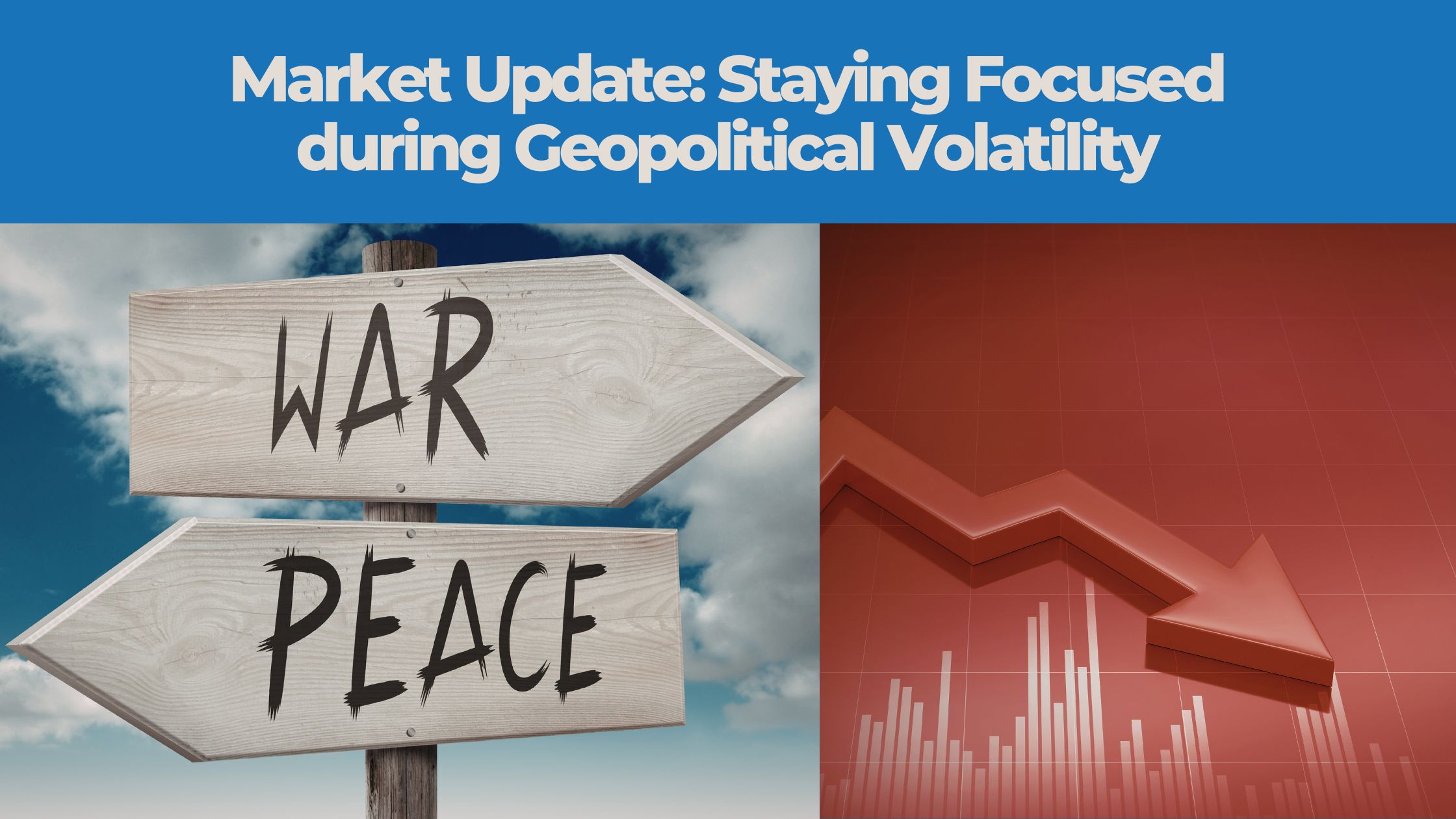
How Geopolitical Tensions Impact Markets — And What Investors Should Do
Published on: March 2026
Over the past few days, global financial markets have been reacting to escalating tensions between the United States, Israel, and Iran. Geopolitical developments in the Middle East typically create uncertainty in global markets, particularly due to their potential impact on crude oil prices and energy supply.
As a result, short-term volatility has been visible across global markets, including India.
It is important to recognize, however, that the current conflict is still in its early stages. Markets are reacting largely to uncertainty and headlines rather than measurable economic damage. At this point, there is limited clarity on how long the situation may last or how it may evolve.
Market Reaction: Driven by Uncertainty
Interestingly, despite the seriousness of the situation, markets have not fallen as sharply as one might expect.
On March 5th, markets rose by 1.17% after early signals suggested the conflict might not escalate severely. However, this optimism was short-lived, as markets declined by 1.27% the very next day.
This kind of movement highlights a key reality — during uncertain times, markets become highly reactive and move dynamically with every new piece of information.
What History Tells Us
History provides valuable perspective during such periods. Global markets have faced similar geopolitical shocks before, including:
- The Gulf War
- The Iraq War
- Recent West Asia tensions
In most cases, markets initially reacted negatively due to uncertainty around oil supply and global growth. However, once the scale and duration of the conflict became clearer, markets stabilized — and often recovered strongly.
[Chart courtesy – ACE Equity]
The Real Risk: Duration of the Conflict
The long-term impact on markets is not determined by the conflict itself, but by how long it persists.
If tensions ease within a few weeks, the economic impact is likely to remain minimal. Businesses do not fundamentally change their long-term growth prospects because of short-term geopolitical disruptions.
However, if the conflict extends over several months and leads to sustained increases in crude oil prices, the impact could become more significant.
India, being a major importer of crude oil, is particularly sensitive to prolonged increases in energy costs. Over time, this could influence:
- Inflation
- Corporate profit margins
- Economic growth expectations
Even in such scenarios, markets typically adjust gradually as clarity improves.
What Investors Should Do
During periods of uncertainty, the most important principle for investors is to avoid emotional decision-making.
Reacting to every headline-driven movement often turns a long-term investment strategy into short-term trading — leading to poor outcomes such as selling in panic and missing recoveries.
A Smarter Approach: Staggered Investing
Instead of trying to predict the exact market bottom, a more practical strategy is to invest gradually.
Deploy capital in 3–4 tranches over time:
- If markets fall further → you can invest at lower levels
- If markets recover quickly → you already have exposure
This approach balances risk and opportunity effectively.
Opportunity in Volatility
Periods of uncertainty often create attractive opportunities for disciplined investors.
Corrections driven by fear — rather than fundamentals — tend to bring high-quality companies to more reasonable valuations.
Currently, several mid-cap and small-cap stocks are already trading at more attractive levels following recent corrections.
The Long-Term Perspective
Ultimately, the value of businesses is determined by:
- Earnings potential
- Competitive advantage
- Long-term growth prospects
Temporary geopolitical disruptions do not alter these fundamentals.
While current headlines may appear concerning, they do not change the long-term growth trajectory of the Indian economy or fundamentally strong companies.
Final Takeaway
For long-term investors, the right approach is simple:
- Stay disciplined
- Avoid reacting to short-term noise
- Use volatility as an opportunity
Periods like these may feel uncomfortable, but history consistently shows that they often present some of the best opportunities for patient investors.
With warm regards,
Your Investment Team



Leave a Reply