Your portfolio looks good. But how’s your actual life plan looking?
Your portfolio can tell you how your investments are performing.
But can it tell you whether you are on track to buy your home, fund your child’s education, retire comfortably or indulge in things in your life which actually matter to you? That’s the difference between a mere portfolio and a financial life plan.
Your investments may be doing well, but your plan can still need a review.

Ask yourself:
Have your goals changed?
Marriage, education, home purchase or retirement plans may look different today.
Is your cash flow healthy?
Are your income, expenses, savings and investments still balanced?
Is your emergency fund enough?
Unexpected expenses shouldn’t force you to sell long-term investments.
Is your family protected?
Review your insurance and financial protection as responsibilities change.
Are your loans under control?
Your EMIs should fit comfortably alongside your goals and investments.
Are your nominations and documents updated?
A well-organised financial life also makes things easier for your family.
Are your investments still aligned with your goals?
A good investment isn’t simply one that delivered the highest recent return. It should match your goal, time horizon and risk profile.
A good portfolio can make you wealthier. A good financial plan helps make that wealth meaningful.
Because your investments should follow your life goals – not the other way around.
Review. Realign. Move forward.
👉 Your Portfolio May Be Doing Well. But Is Your Financial Plan Still on Track? →
(Contributed by Riya Bhandari, Relationship Manager, Team Arjun, Hum Fauji Initiatives)
Invested in Equity for 2 Years and Still at Zero: What’s Happening?
Imagine investing in equity for two years and seeing almost no growth.
Your first thought may be: ‘Maybe I should exit now and get in later.’
But look at what history tells us.
[CAGR: Compounded Annual Growth Rate]
Source: Edelweiss Mutual Fund
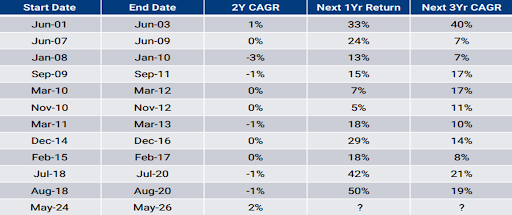
The table above shows several periods when the market delivered 0% or negative CAGR over two years. Interestingly, every one of these periods was followed by positive returns over the next one and three years.
For example:
- Jun 2007–Jun 2009: 0% CAGR → 24% next-year return → 7% CAGR over the next 3 years.
- Jul 2018–Jul 2020: -1% CAGR → 42% next-year return → 21% CAGR over the next 3 years.
- Aug 2018–Aug 2020: -1% CAGR → 50% next-year return → 19% CAGR over the next 3 years.
And the latest period? May 2024–May 2026: 2% CAGR. What happens next? We don’t know yet.
Takeaway
A two-year period tells you what has happened. It doesn’t necessarily tell you what will happen next. So before exiting an equity investment because returns have been disappointing, ask yourself:
- Has my goal changed?
- Has the investment thesis changed?
- Or has the market simply gone through a difficult phase, as it has done so many times in the past?
Sometimes, patience isn’t about waiting blindly. It’s about giving the investment the time its goal requires.
(Contributed by Anjali Tomar, Relationship Manager, Team Arjun, Hum Fauji Initiatives)
👉 Your Equity Investment Hasn’t Grown in 2 Years. Is That Really a Reason to Exit? Find Out →
Before You Commute Your Pension, Know the Numbers
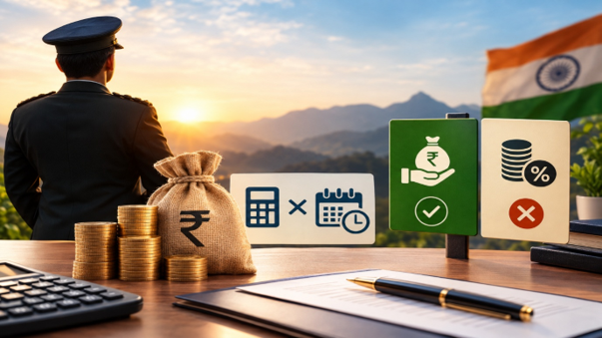
For a Defence officer, retirement pension is a lifelong income stream. Commuting a portion of it provides a substantial lump sum today – but reduces the monthly pension for the next 15 years, until the commuted portion is restored.
How Does Commutation Work?
Retiring pension is generally 50% of the last-drawn reckonable emoluments or the average reckonable emoluments of the last 10 months, whichever is more beneficial, subject to applicable rules. A Defence officer may commute up to 50% of the pension admissible, as per applicable rules.
Formula:
Commuted Value = Commuted Pension × 12 × Commutation Factor
The commutation factor depends on the officer’s age on the next birthday. Table annexed to the CCS (Commutation of Pension) Rules, 1981 provides the commutation factor and is also available on the official website of the Principal Controller of Defence Accounts (PCDA) Pension.
A Realistic Example
Lt Col XYZ, aged 54, wants to commute 50% of the pension.
- Basic Pay: ₹1,32,400
- DA: ₹85,782
- MSP: ₹15,500
- Retiring Pension: ₹1,16,841
- Commuted Pension: ₹58,420
- Commutation Factor: 8.627 for age 55 years (‘age next birthday’)
Commuted Value = ₹58,420 × 12 × 8.627 = ₹60.48 lakh approx.
The commuted portion is restored after 15 years, subject to applicable rules.
For a government employee, the commuted pension received is exempt under Section 10(10A), while regular pension is taxable subject to the applicable tax rules.
Before You Commute, Ask:
- Do I actually need the lump sum?
- How much do I require?
- Can I use it to repay liabilities?
- How will I invest the amount?
- Can the investment compensate for the reduced monthly pension?
- What will I receive if I commute versus retaining the full pension?
The decision is not only about the lump sum received today, but also about the regular income you give up for the next 15 years.
(Contributed by Aditya Bhola, Relationship Manager, Team Sukhoi, Hum Fauji Initiatives)
👉 Taking the Lump Sum or Keeping the Pension? Know What You’re Giving Up Before You Commute →
What did our clients ask us in the last 7 days?
Query – I am 38 years old and planning to fund my child’s higher education, for which approximately ₹35 lakhs will be required for a private medical college. I have been investing for the past 15 years and have accumulated around ₹40 lakhs in mutual funds. Should I redeem my mutual fund investments to fund the education expense, or would it be more appropriate to take an education loan and continue with my investments?
Our Revert –
This isn’t simply a choice between ‘loan Vs investments.’ It is about funding an important goal while protecting your family’s long-term financial security.

Let’s look at three possible approaches:
1️⃣ Use your investments
Redeem ₹35 lakhs and retain ₹5 lakhs invested. This avoids any EMI or interest burden. However, ₹35 lakhs could potentially grow to around ₹86.7 lakhs in 8 years if it remained invested at 12%.
2️⃣ Take the entire Education loan
Borrow ₹35 lakhs and keep the ₹40 lakhs invested. At an assumed 9% interest for 8 years, the EMI would be approximately ₹51,276 per month, with total interest of around ₹14.2 lakhs.
3️⃣ Use a combination
Use ₹20 lakhs from the portfolio and borrow ₹15 lakhs. The EMI would be approximately ₹21,900 per month, with total interest of around ₹6.1 lakhs. The remaining ₹20 lakhs could potentially grow to around ₹49.5 lakhs in 8 years at an assumed 12% return.
So, what could be the right path?
Taking out almost all the money for one goal and leaving others in a lurch may not be the right way to handle a financial plan.
If the EMIs of ₹51,000 can be managed and investments are earning more than the loan interest, education loan for the entire amount makes sense.
A combination of investments + a manageable loan may help balance education funding, EMI burden and continued wealth creation – depending on your cash flow, risk capacity and other financial goals.
Please note that the objective isn’t simply to minimise interest or maximise investment returns. It is to fund your child’s education without compromising your family’s long-term financial security. Depending on your life’s situation, there could be a give-and-take either way to handle the situation – it will be good to discuss this with your financial planner to come to the best solution for you.
(Contributed by Team Arjun, Hum Fauji Initiatives)
👉 Education Loan or Your Investments? Don’t Decide Without Looking at the Bigger Financial Picture →