
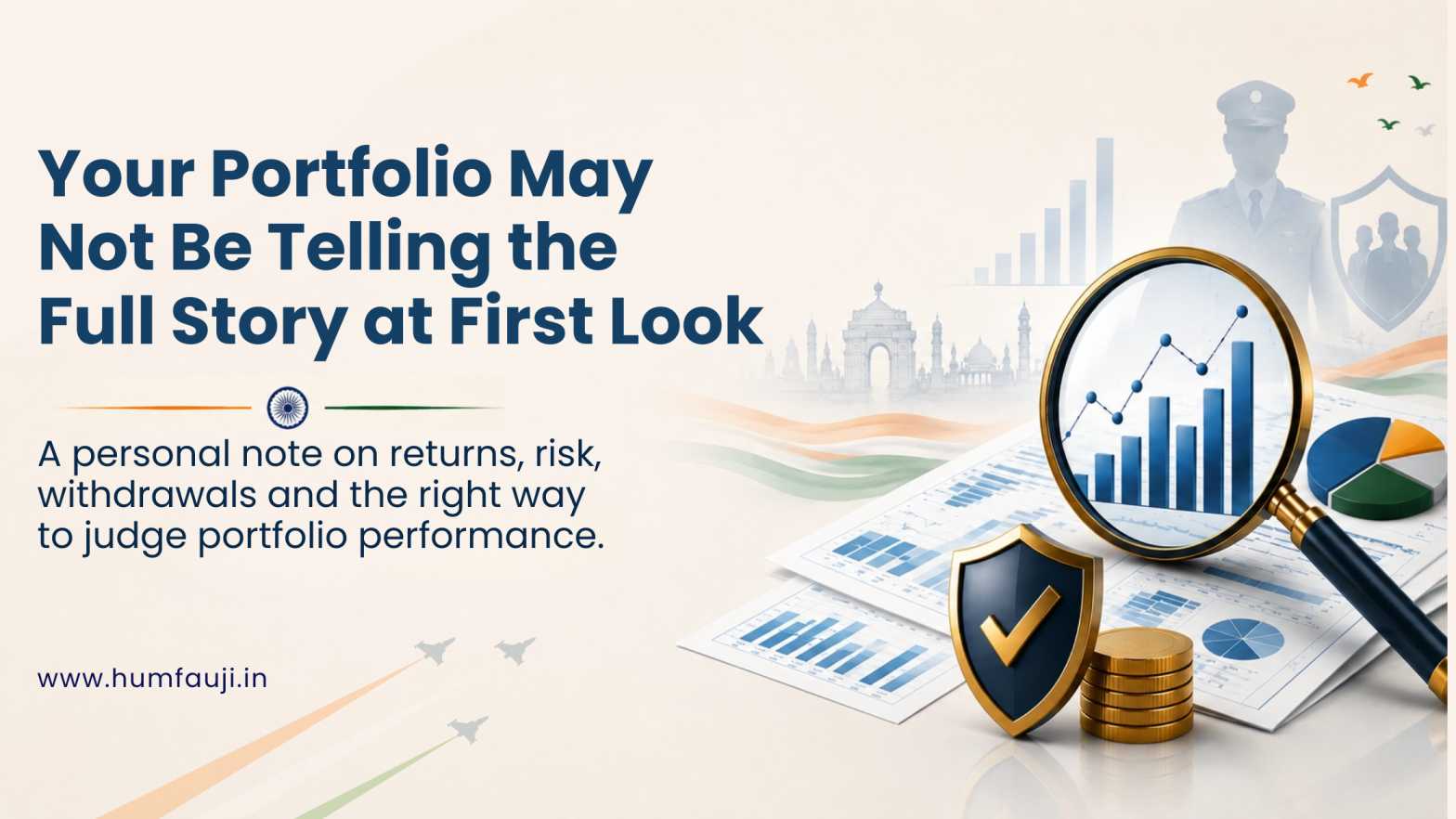
A personal note on returns, risk, withdrawals and the right way to judge portfolio performance
Over the past few weeks, I have personally gone through several concerns raised by our investors regarding portfolio returns.
Some concerns are natural. Markets have not been easy for some time. And the portfolio values are not moving the way they were moving earlier. Many investors are wondering whether their portfolio is doing enough, whether the right funds have been selected, whether changes should have been made earlier, or whether they would have done better elsewhere.
These are fair questions. In fact, a good investor must ask questions.
At the same time, I felt it may be useful to share one important thought with all of you — very often, the first look at a portfolio does not tell the complete story.
When we look only at the current value or the headline return, we may miss some very important factors — the risk profile chosen, the equity-debt allocation, withdrawals made in between, money shifted out, dividends received, time actually spent in the market, tax impact, and the purpose for which the money was originally invested.
A portfolio must be judged in totality, not only by one number. Let me explain this in simple terms.
Risk and Return Must Be Looked at Together
If an investor had asked for a safer portfolio, or if the portfolio was deliberately kept conservative because of age, comfort level, near-term requirements or lower risk appetite, then the return from such a portfolio cannot be compared with a 100% equity portfolio.
Safety has a cost; stability has a cost; and lower volatility has a cost. A conservative portfolio will protect better in difficult times, but it will usually not run as fast as an aggressive equity portfolio in good times.
Similarly, if money has been withdrawn over the years for personal use, or shifted elsewhere, the portfolio cannot be judged as if the entire original amount remained invested throughout.
Many times, an investor remembers the original investment amount, but forgets that a substantial amount was redeemed, used, shifted or received separately. Once we include those cash flows, the picture can look very different.
Be Careful When Comparing Your Portfolio
Another common issue is comparison.
We may compare our portfolio with a friend’s portfolio, a relative’s portfolio, a fund shown on an app, or something spoken about by an influencer on social media. But unless the risk taken is the same, the time period is the same, the asset allocation is the same, and the cash flows are the same, such comparisons can easily mislead us.
A person with 90% equity exposure may show better returns in a rising market than someone with 50–60% equity exposure. But the same person will also face a much sharper fall when markets turn.
Return cannot be separated from risk.
Every Investment Product Has a Different Role
The same applies to product comparison. A debt fund, balanced advantage fund, hybrid fund or conservative allocation cannot be expected to behave like a mid-cap, small-cap or pure equity fund.
These products have different roles. Some are meant for growth; some for stability; some are meant to reduce volatility and some others are meant to provide liquidity.
A portfolio needs all these roles depending on the investor’s situation.
Our Responsibility Is Not to Chase Returns
At Hum Fauji Initiatives, our responsibility is not to chase the latest fashionable fund or the highest recent return.
Our responsibility is to build a portfolio that is suitable for the investor’s goals, risk appetite, time horizon and real-life requirements so that future life-time requirements are met at an acceptable level of risk.
This does not mean that every fund will always perform well. It also does not mean that every recommendation made in the past will remain suitable forever.
Markets change. Fund managers change. Fund strategies change. Investor needs also change.
Wherever a fund or allocation requires correction, we must have the honesty to recommend that correction.
But we must also have the discipline not to change a portfolio merely because something else has done better in the recent past or simply promises to be better.
More Changes Do Not Always Mean Better Returns
Frequent changes may look active, but they do not always create better wealth. They can create tax impact, exit loads, disruption in compounding, and sometimes unnecessary confusion.
Good investing is not about constantly doing something. Many times, it is about doing the right thing and then allowing it enough time to work.
Mere activity may not translate into progress.
We Also Need to Explain Portfolios Better
I also want to say this with humility. If many investors are asking similar questions, then it is also a reminder to us that we must explain portfolios better and more often.
We must help our investors understand not only what has been recommended, but why it has been recommended.
A portfolio review should not become only a list of schemes and returns. It should explain the logic, the risk, the role of each asset class, and whether the portfolio is still aligned with your life goals.
That is the standard we must keep improving towards.
Before Judging Your Portfolio, Ask These Questions
So, whenever you look at your portfolio, please ask these questions before reaching a conclusion:
- Was my portfolio designed for safety, growth, income, liquidity or a balance of these?
- How much equity risk was I actually willing to take?
- Have I withdrawn or shifted money in between?
- Am I comparing my portfolio with the correct benchmark?
- Am I judging a long-term investment based on a short-term market phase?
- Has my goal or risk appetite changed since the portfolio was originally made?
When Should You Review Your Portfolio?
If your answers suggest that the portfolio is no longer aligned with your needs, please ask your Relationship Manager at Hum Fauji Initiatives for a structured review.
We will examine it seriously and dispassionately. If a correction is required, we will say so. If patience is required, we will say that too.
Our commitment remains the same as it has always been — to protect the financial interests of armed forces personnel, avoid unnecessary risk, and help them create sustainable long-term wealth with clarity and discipline.
Markets will keep going through good phases and bad phases. Fund performance will also move in cycles.
But the investor who understands his portfolio properly is far less likely to take emotional decisions at the wrong time.
Please do not judge your portfolio only by the first glance. Look at the full story.





Leave a Reply