
Quick answer
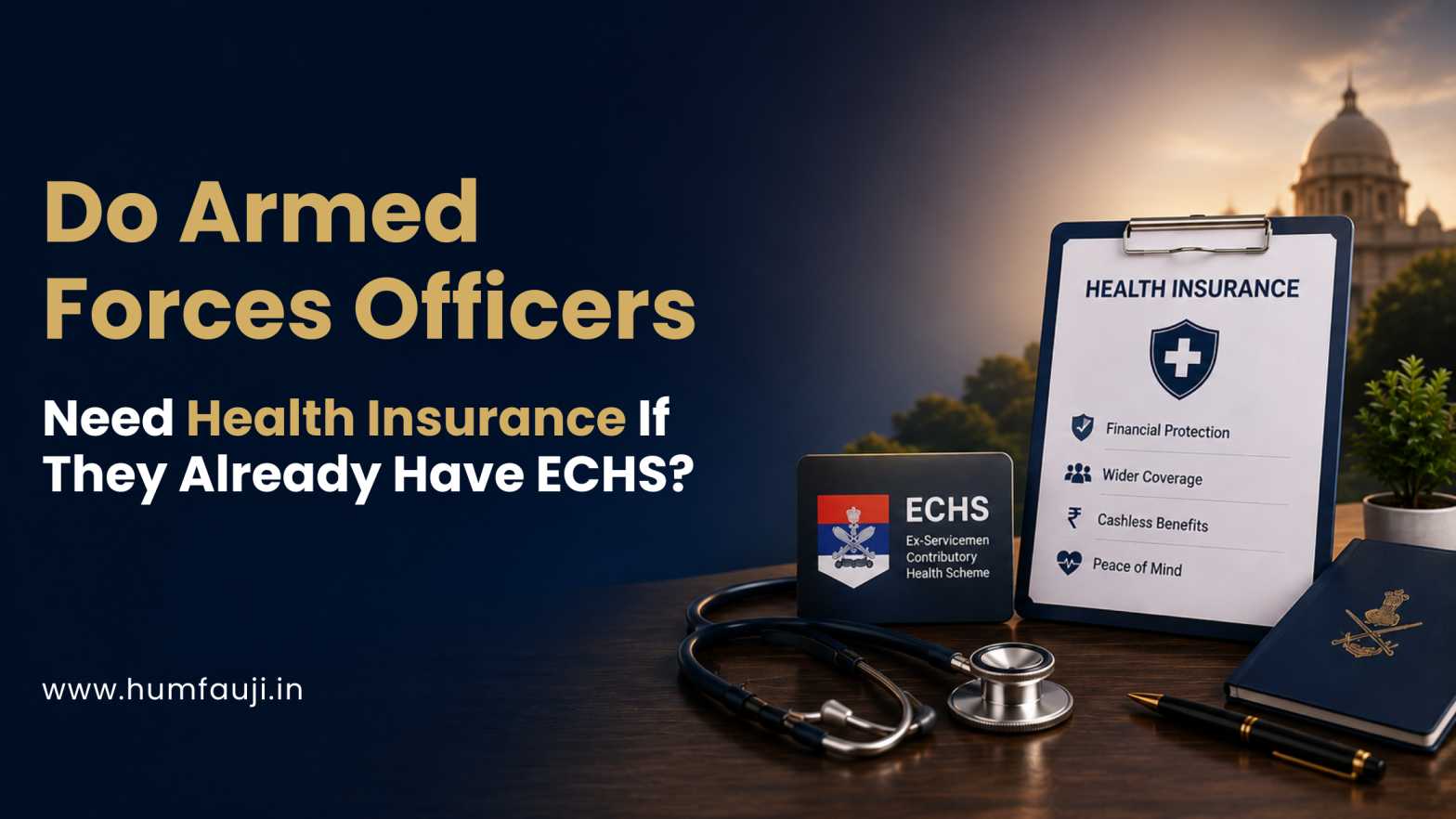
ECHS is an extremely valuable healthcare benefit for retired Armed Forces personnel and their eligible dependants. A serving officer similarly has access to comprehensive service medical facilities. Therefore, private health insurance is not automatically necessary for every military family.
However, institutional medical cover and personal health insurance do not perform exactly the same role. A separate policy may provide greater choice of hospitals, easier access when the family is living away from a military station, continuity for children who may eventually cease to be dependants, and an additional financial option during an emergency. The decision should be based on the family’s circumstances – not on fear, sales pressure or a general belief that everybody must buy a health insurance.
Why this question deserves a considered answer
Many Armed Forces officers understandably ask why they should pay for health insurance when substantial medical support is already available to them.
It is a fair question. ECHS provides eligible ex-servicemen and their dependants access to treatment through its network of polyclinics, service hospitals and empanelled healthcare organisations. Treatment at empanelled hospitals is intended to be cashless when undertaken according to ECHS procedures and entitlements.
For many veterans, this benefit may remain the principal – and sometimes sufficient – source of healthcare throughout retirement. It should not be dismissed merely because private insurance is widely marketed.
The more useful question is not, ‘Is ECHS good enough?’ It is:
Would an additional personal health policy give this particular family meaningful flexibility, continuity or protection that it does not presently have?
The answer will differ from one family to another.
Where personal health insurance may add value
1. The family may not always be near the preferred medical network: Military families are accustomed to postings, separations and frequent changes of location. Even after retirement, the officer, spouse, children and dependent parents may be living in different cities.
ECHS has a substantial healthcare network, but the practical experience of using any institutional scheme depends upon the facilities and empanelled hospitals available in the place where treatment is required. A private health policy may provide access to an additional hospital network, subject to the policy’s terms.
This does not make private insurance inherently superior. It simply provides another route when location, convenience or medical preference matters.
2. The family may want greater choice during a serious illness: In routine healthcare, the existing institutional system may work very well. During a complex surgery, cancer treatment or prolonged hospitalisation, however, a family may strongly prefer a particular hospital or specialist. ECHS procedures provide for treatment in empanelled hospitals and also contain rules relating to emergencies, referrals, non-empanelled hospitals and reimbursement. The amount ultimately admissible may depend upon the applicable procedure, entitlement and approved rates.
A personal health policy can sometimes widen the family’s options, although it too will have network restrictions, exclusions, room eligibility and claim conditions. The right comparison is therefore not ‘government scheme versus private treatment’. Neither should be understood so simplistically.
3. Children’s eligibility and circumstances will change: A child who is currently covered as a dependant will not necessarily remain in the same position throughout life. Education, employment, marriage, age and income can affect dependency and eligibility under institutional arrangements.
Buying personal health insurance after a medical condition has developed can be more difficult or expensive. The condition may be subject to a waiting period, exclusions or altered underwriting terms. Under current IRDAI rules, waiting periods – including those relating to pre-existing diseases – cannot generally exceed 36 months, though the actual policy wording remains important. For adult children, particularly those studying or beginning their careers, an independent policy may therefore be worth considering before the family is compelled to act.
4. A serving officer’s civilian career may begin before normal retirement: Not every officer serves until superannuation. Some leave the Services early and move into corporate employment, entrepreneurship or consultancy. The family’s healthcare arrangements may then change considerably. Employer insurance may be available, but such cover belongs to the employment relationship. It may reduce, change or disappear when the job changes.
A personally owned policy provides continuity independent of the employer. It can be retained across career changes, subject to regular renewal and policy conditions.
5. Institutional eligibility does not remove every practical difficulty
A medical benefit may be comprehensive and still involve referrals, approvals, documentation, empanelment rules or reimbursement procedures in particular situations. ECHS itself publishes detailed instructions and regularly updates policies concerning referrals, medicines, non-empanelled treatment and specialised procedures.
This is not a criticism of ECHS. Every organised healthcare or insurance system must have procedures. The planning question is whether the family would value a second source of access when circumstances become inconvenient or urgent.
A practical example
Consider a retired Colonel and his spouse living in a Tier-II city. Both are eligible for ECHS and are satisfied with the facilities available locally. Their daughter works in Bengaluru and their son is studying abroad. The couple may reasonably decide that they do not need an expensive, high-cover private family policy merely because somebody has warned them about rising healthcare costs. ECHS may continue to be their primary medical arrangement.
They may nevertheless examine three separate questions:
- Would a modest personal policy or super top-up give them useful access to additional hospitals?
- Should their daughter have an independent policy linked to her own circumstances?
- Does their son require appropriate health cover in the country where he is studying?
One family can therefore arrive at three different answers without being inconsistent.
When additional health insurance may not be necessary
A separate policy may add limited value where:
- The officer and spouse are comfortable using the available service and ECHS network
- Suitable empanelled facilities are accessible
- They understand and can follow the required procedures
- Dependants have appropriate cover of their own
- Sufficient liquid funds are available for expenses that may not be immediately reimbursed
- The additional premium would place unnecessary pressure on retirement cash flows
Insurance should not be purchased merely to create psychological comfort. If the cover is unlikely to be used, duplicates existing benefits and consumes a disproportionate part of the family’s income, the decision deserves reconsideration.
When a private policy deserves serious consideration
It may be more useful where:
- The family lives in different locations
- Access to preferred empanelled hospitals is limited
- Members want wider hospital choice
- An officer is planning premature retirement or a civilian career
- Adult children may soon cease to qualify as dependants
- The family has a strong preference for private healthcare
- Premiums are still affordable before age and medical conditions make new cover difficult
Even here, the answer need not be an expensive base policy. A carefully selected combination of existing institutional benefits, a modest personal cover and a super top-up may sometimes be more efficient.
Common mistakes Armed Forces families should avoid
Assuming that more insurance is always better: Duplicate cover is not automatically useful. The premium must be justified by an identifiable gap.
Waiting until retirement to examine the issue: Age and medical history can materially affect the availability and cost of a new policy. The review should take place while choices are still open.
Buying only because the premium appears low: Low premiums may accompany deductibles, room restrictions, co-payments, limited hospital networks or exclusions. The policy must be understood before it is purchased.
Ignoring the spouse and adult children: The officer may know every detail of ECHS and insurance arrangements, while the spouse knows very little. Medical documentation, cards, policy numbers and claim procedures should be understood by more than one family member.
Cancelling an existing policy casually: A policy held for several years may have completed important waiting periods. Replacing it only to save a small premium can destroy accumulated continuity benefits. Any cancellation or migration should be evaluated carefully.
The financial-planning view
For an Armed Forces family, health protection should be designed in layers.
The first layer may be the excellent institutional medical support arising from service.
The second may be personal health insurance where it adds genuine flexibility.
The third is an adequate emergency fund for expenses, travel, attendants, medicines or other costs that may arise around treatment.
No single layer should be examined in isolation.
The decision is therefore not whether ECHS or private health insurance is ‘better’. The real task is to identify what the family already has, where the practical gaps lie, and whether paying an additional premium is the most efficient way to close them.
Key takeaway
ECHS and service medical facilities are substantial benefits and may adequately meet the requirements of many Armed Forces families. Private health insurance should not be bought merely because it is commonly recommended.
At the same time, a separate policy can provide useful continuity, wider choice and greater flexibility for some families – especially where members live in different cities, children are approaching financial independence, or an officer expects to transition into civilian life.
The right decision is personal. It should emerge from a review of eligibility, location, family structure, healthcare preferences, existing policies and affordability.
Frequently asked questions
Can an ECHS beneficiary also hold private health insurance?
Yes. Holding private health insurance does not, by itself, prevent an eligible person from retaining ECHS benefits. Claims and treatment must be handled according to the rules of the facility or policy being used.
Should I surrender my existing health policy after becoming eligible for ECHS?
Not without examining its age, completed waiting periods, coverage, exclusions and premium. An older policy may contain valuable continuity benefits that may not be easy to recreate later.
Is employer health insurance enough for a serving spouse or adult child?
It may be adequate during employment, but it is not personally controlled and may end when the employment ends. A separate policy, at least a good super top-up, can provide continuity across job changes.
Is a super top-up sufficient?
A super top-up can provide high-value protection above a specified deductible at a relatively economical premium. However, the family must be able to meet the deductible through ECHS, another policy or even personal funds. It should not be purchased without understanding how claims will operate.
At what age should personal health insurance be considered?
There is no single correct age. In general, the review is better undertaken while the individual is healthy and has several policy choices, rather than after a diagnosis or immediately before retirement.
A final word
The strongest medical arrangement is not necessarily the one with the highest sum insured. It is the one the family can actually access, understand and continue when it is most needed.
Hum Fauji Initiatives helps Armed Forces officers and their families examine existing service benefits, personal policies, family requirements and retirement cash flows before deciding whether additional health insurance is genuinely necessary.
This article is intended for financial education. ECHS procedures, insurance regulations, eligibility conditions and individual policy terms may change. Readers should verify the current rules and obtain personalised advice before acting.





Leave a Reply