
15 Mutual Funds, 3 Advisors, 3 Apps – But Who Owns Your Financial Strategy?
Having multiple mutual funds, investment apps and even different advisors can give you a comforting feeling: “I’m diversified.” But diversification isn’t simply about having more investments, more advisors and more platforms.
Imagine a family with 15 mutual funds spread across different platforms. Each fund looks good individually. But when someone reviews the complete portfolio, they discover that several funds own many of the same things.

Now imagine that the family has a child’s education goal five years away, a home loan to manage and retirement still 15 years away. The question isn’t whether they have enough investments. The question is whether the right money is positioned for the right goal.
This is where financial planning becomes different from simply buying financial products.
A coordinated financial plan looks at your:
- Goals
- Time horizons
- Risk
- Cash flows
- Existing investments
It then connects these pieces into one strategy – and reviews them as your life changes.
Think of it like a cricket team. Having 11 good players doesn’t guarantee a winning team. Each player needs a role, and someone needs to ensure they are playing towards the same objective.
Don’t ask: “How many investments or advisors or platforms do I have?”
Ask: “Does every investment have a purpose and do they work together?”
More products create a portfolio. A coordinated strategy creates a financial life plan.
👉 Have Multiple Funds and Advisors? Is Your Money Actually Working as One Plan? Find Out →
(Contributed by Ankit Kumar Singh, Relationship Manager, Team Prithvi, Hum Fauji Initiatives)
Child’s Name. Your Money. Whose ITR?
Putting investments in your child’s name is a common way to build wealth for their future.
But here’s something many parents may not realise:
The name on the investment does not necessarily decide who pays the tax.
Suppose you invest in a mutual fund, FD or shares in your minor child’s name. If those investments generate taxable income, the income is clubbed with the income of the parent whose total income is higher, subject to applicable exceptions.
So, simply putting an investment in your child’s name does not automatically shift the tax liability to the child.

But there are exceptions.
Income earned by a minor through his/her own skills, talent or specialised knowledge can be treated differently, e.g., winning a talent competition, making an app to earn money, and earnings through own effort. The rules can also differ in specified cases involving a child with a disability.
What should parents do? Think beyond just “Whose name should the investment be in?”
Also consider:
- Who will be taxed on the income?
- Where did the investment money come from?
- Is the income being reported correctly?
- Are the investment and tax records properly maintained?
Filing an ITR for a minor may also be relevant in certain situations, but it should not be assumed that every investment in the child’s name needs a separate return.
Investing in your child’s name can build their financial future. But the tax treatment may still come back to the parent. Before investing, look at both sides of the equation: Wealth creation today + Tax planning tomorrow.
👉 Investing in Your Child’s Name? But Whose Income Is It for Tax? Find Out →
(Contributed by Pregya Bansal, Relationship Manager, Team Dhanush, Hum Fauji Initiatives)
You Retired With ₹2 Crore. Now What?
₹2 crore at retirement sounds like a big number.
But here’s the question that matters more: “How long does ₹2 crore need to support you?”

Let’s say your:
- Retirement corpus: ₹2 crore
- Current monthly expenses: ₹1 lakh
- Current annual expenses: ₹12 lakh
- Inflation: 6% p.a.
- Retirement period: 30 years
Now look at what happens to your expenses:
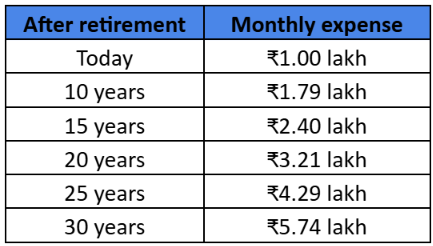
So, an expense of ₹1 lakh today could become nearly ₹5.7 lakhs a month in 30 years at 6% inflation.
And there is another number worth noticing: ₹12 lakhs ÷ ₹2 crore = 6%
Your first year’s expenses alone represent a 6% withdrawal from the corpus – before considering taxes, investment returns, healthcare costs, emergencies or unexpected expenses. This is a high withdrawal – normal recommended is 4%.
For an Armed Forces family, pension may provide a dependable income stream and ECHS may support eligible healthcare needs. But your corpus still needs a strategy – how much to withdraw, how much to keep liquid, how much to invest for growth, and how to adjust withdrawals over time. And the previous illustration would surely be true for your children if they are not going to get any pension on their own.
₹2 crore is a number. Retirement is a 25–30 years journey.
The real question isn’t: “Have I accumulated ₹2 crore?” It is: “Can my retirement strategy make this ₹2 crore last my lifetime?”
👉 ₹2 Crore at Retirement Sounds Enough. But Will It Last as Long as You Do? Find Out →
(Contributed by Abhilash Rana, Relationship Manager, HNI Desk, Hum Fauji Initiatives)
What Did Our Clients Ask Us in the Last 7 Days?
Question
My TDS was deducted correctly, but the Income Tax Department is not giving me full TDS credit/refund. Why is there a mismatch and how can I get it corrected?
Our Reply
Please check your Form 16.
It may show TDS deducted: ₹80,000, and you enter the same amount in your Income Tax Return and expect the refund accordingly. But after processing, the Income Tax Department gives you credit for only ₹65,000.
Where did the remaining ₹15,000 go? This may be due to a tax credit mismatch.
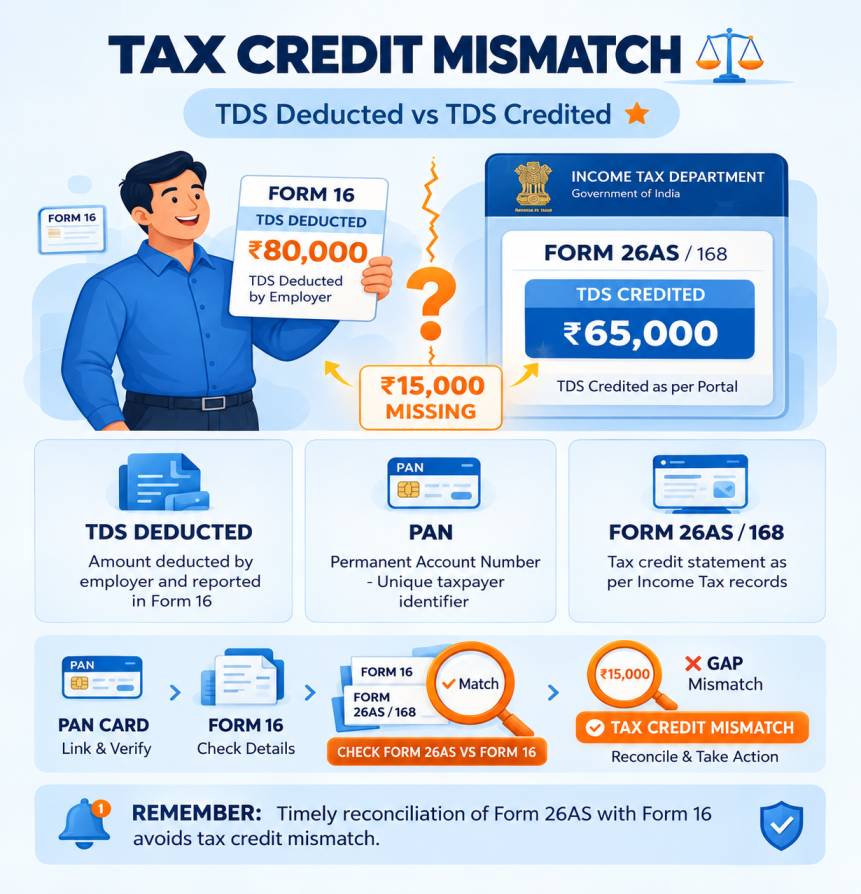
The department checks the TDS claimed in your return against the TDS reported against your PAN in Form 26AS (now Form 168). If your employer deducted ₹80,000 but only ₹65,000 is reported in Form 26AS by mistake or some other reason, the IT department may allow credit only for ₹65,000.
And it does not always mean that you made a mistake.
Sometimes the employer or bank has reported the wrong PAN, TAN, amount, financial year, or has not deposited/reported the TDS correctly. Sometimes the problem is simply timing – especially when the fourth-quarter TDS has not yet appeared because the reporting deadline is later.
So, what should you do?
- Before filing, check Form 26AS/Form 168, Annual Information Statement (AIS) and Taxpayer Information Summary (TIS) against your Form 16 and ITR.
- Do not rely on just one statement.
- If the deductor has made an error, ask them to file a correction statement.
- If your return is already processed, the route will be a rectification request under Section 154 after the corrected TDS appears.
The key is: don’t just check whether TDS was deducted. Check whether it was correctly reported against your PAN so that you get the full and correct credit for it.
👉 TDS Deducted ≠ TDS Credited. Know What to Check Before You File →
(Contributed by Team Dhruv, Hum Fauji Initiatives)