
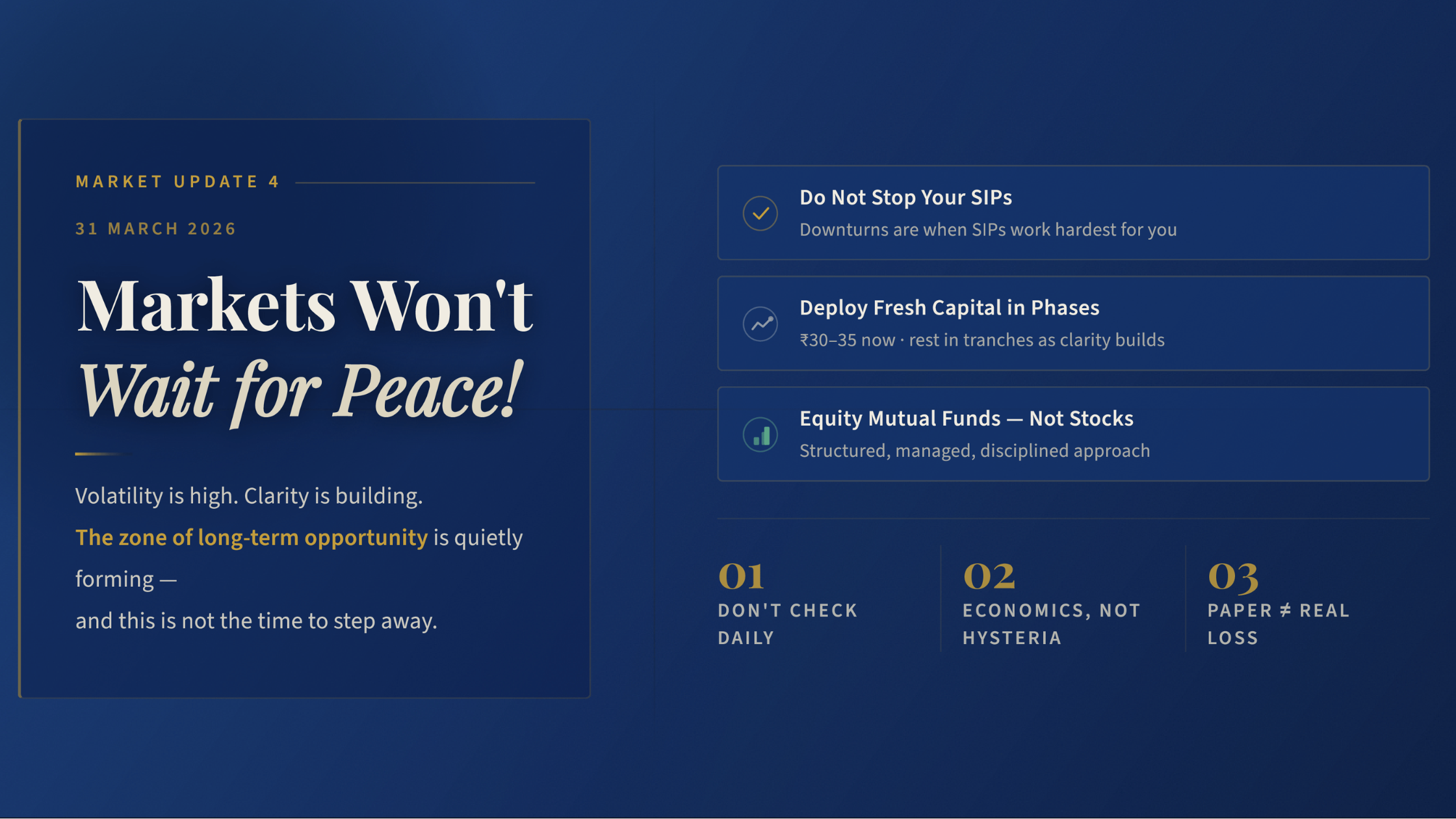
Markets Don’t Wait for Peace — And Neither Should You
Investor Note | March 2026
If you were sitting across from me today, I would tell you this very clearly:
Over the last few days, both the war and the markets have become more volatile — but at the same time, more revealing.Let me explain.
The Iran–US–Israel conflict is no longer just about escalation. We are now seeing clear signs of pressure, positioning, and negotiation attempts happening simultaneously.
On one side, political leadership is alternating between strong rhetoric and shifting negotiation timelines. On the other, counter-parties are presenting negotiating positions — often unrealistic by design.
This is not confusion. This is how conflicts transition from high-intensity confrontation to controlled, prolonged engagement, where each side negotiates from a position of strength.
What This Means for Markets
There is a strong possibility that markets recover the entire fall seen in March — and do so faster than most expect — once signs of de-escalation or stability begin to emerge.
The recent decline has also been amplified by short-term factors such as tax-loss harvesting by domestic investors.
The real risk is not immediate escalation — but a prolonged phase where crude oil remains elevated and begins to impact economic growth meaningfully.
While this is a low-probability scenario, it is not impossible.
Clarity vs Uncertainty
So if you ask the right questions:
- Is the war ending soon? No
- Is clarity improving? Yes — gradually
- Is escalation still possible? Yes — but not the base case
Markets are reacting precisely to this shift — from panic to recalibration.
What Markets Are Signalling Today
Markets always move ahead of reality. They typically bottom out months before economic data looks the worst.
Today, we are beginning to see early signs of that process:
- Fear levels are extremely high
- Sentiment is deeply negative
- Retail participation is turning cautious — even defensive
- Some investors are stopping their SIPs
That last point is critical.
When investors begin to stop systematic investments due to fear, it often signals that emotions are peaking — and markets are moving closer to a bottom than a top.
With the Nifty already down nearly 15% from early January, valuations have corrected meaningfully — even after accounting for potential slowdown.
This does not mean the exact bottom is here — but it strongly suggests we are entering a zone of long-term opportunity.
So, What Should You Do Now?
1. Do Not Stop Your SIPs
If there is one thing to emphasize, it is this: do not stop your SIPs.
Falling markets allow SIPs to accumulate more units at lower prices — these are the very investments that drive disproportionate returns during recovery.
Stopping SIPs now is like refusing to buy when everything is on a clearance sale.
2. Start Deploying — But With Structure
If you have available capital, avoid both extremes — do not stay idle, and do not go all-in.
A practical approach:
If you have ₹100 → deploy ₹30–35 now, and stagger the rest.
The goal is not to catch the exact bottom — but to participate in the zone where value is building.
3. Use This Phase Strategically
This phase is especially relevant if you have recently:
- Retired
- Sold property or assets
- Received a large inflow
- Or are holding an underperforming portfolio
It offers a strong opportunity to restructure and deploy capital — deliberately, not emotionally.
Where Should You Invest?
Let’s be very clear:
For most investors, equity mutual funds are a more effective approach than direct stocks.
Professional fund managers handle allocation, timing, and risk management — areas where most individual investors struggle.
Structured approaches like STP (Systematic Transfer Plans) help deploy larger capital gradually, reducing timing risk.
At the same time:
- Increase SIPs where possible
- Avoid overexposure to equity
- Do not let FOMO override discipline
And if you are not following a structured plan, this is the time to align with a professional advisory framework.
One Final Perspective
This is not an easy phase — but it is a defining one.
Periods like these feel uncomfortable because:
- News flow is negative
- Uncertainty is high
- Outcomes are unclear
But these are also the periods where:
- Valuations correct
- Fear peaks
- Opportunities quietly build
You do not need to predict the war.
You do not need to time the market perfectly.
You simply need to ensure that you do not step away at the wrong time.
Because markets won’t wait for peace — and neither should you.
Col Sanjeev Govila (Retd)
CEO, Hum Fauji Initiatives
9999 022 033
PS — Three cardinal rules in such scenarios:
• Do not check your portfolio more than once every 2–4 weeks
• Do not equate war headlines with long-term market direction
• Losses only become real when you act on fear and exit prematurely













Leave a Reply