
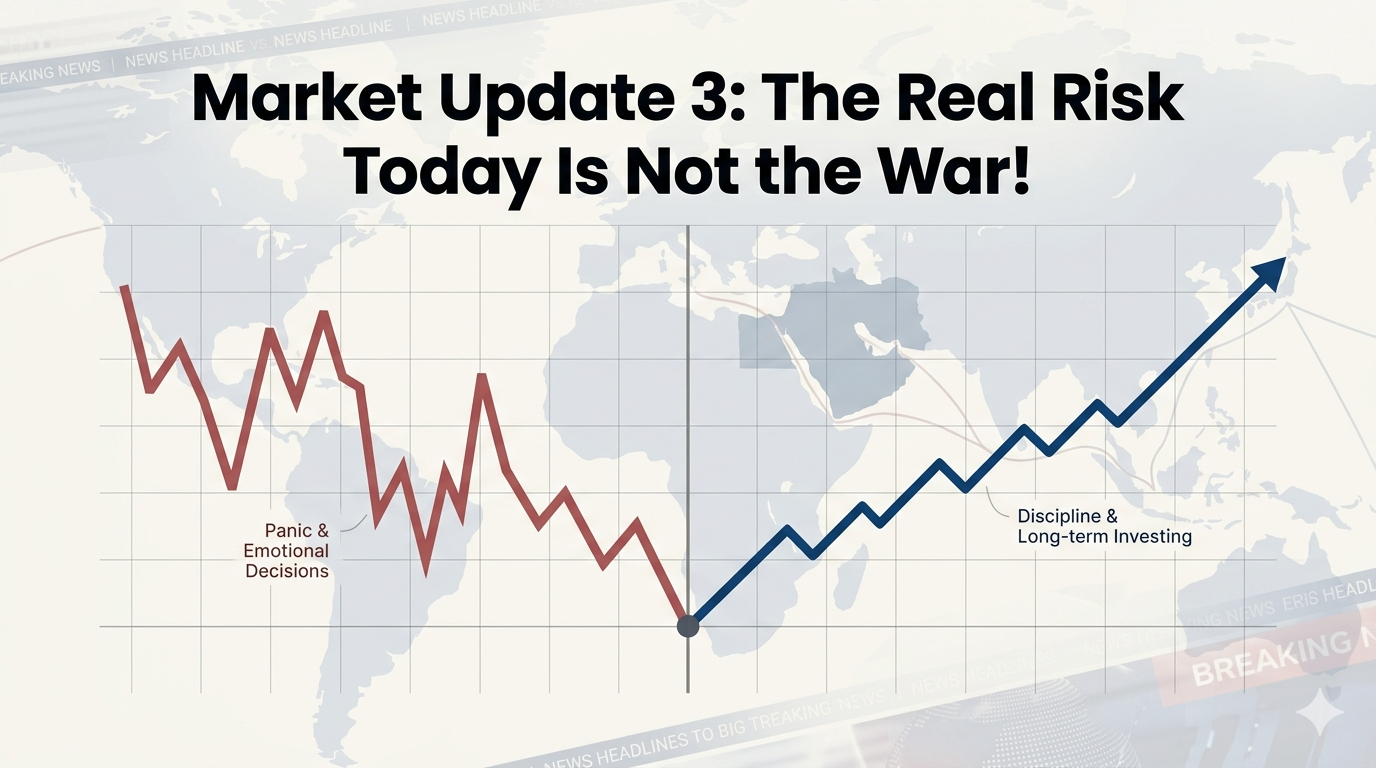
Markets, War & Investor Behaviour: What Really Matters Right Now
Weekly Investor Note | March 2026
Over the past week, the Iran–US–Israel conflict has continued to evolve — but not in the way markets initially feared. :contentReference[oaicite:0]{index=0}
This is evident in market behaviour itself. Despite intense headlines, several trading sessions have closed in the green, suggesting that markets are beginning to differentiate between uncertainty and actual economic damage.
What we are witnessing so far is a phase of controlled escalation, rather than an all-out war. This distinction is critical.
The Real Trigger: Oil, Not Headlines
The most important development this week has been pressure on global oil supply routes, particularly around the Strait of Hormuz.
Even the possibility of disruption has pushed crude oil prices higher — and this has been the primary driver of volatility across global markets.
For India, this becomes the key variable to monitor.
- India imports over 80% of its crude oil
- Higher oil prices can impact inflation and currency stability
- Corporate margins may compress in energy-intensive sectors
However, it is important to note: markets are currently pricing in risk, not reacting to actual economic disruption — at least for now.
Where Markets Actually Stand Today
Amid all the geopolitical noise, one important reality is often overlooked: valuations have already corrected meaningfully.
- Nifty 50: P/E has declined from ~24.4 to ~20.9, now trading ~11% below its 10-year average
- Midcaps: Strong earnings growth has normalized earlier elevated valuations
- Small caps: Now trading nearly 15% below historical averages after correction
In simple terms, markets are no longer priced for perfection.
Earnings (largely pre-war) have remained stable, while prices have corrected — creating a more favorable entry environment compared to a year ago.
The Bigger Risk: Trying to Outsmart the Market
During uncertain times, a common instinct is:
“Let me sell now, wait for clarity, and buy back later.”
While this sounds logical, it is rarely effective in practice.
Consider this:
An investment of ₹5,00,000 grows to ₹10,00,000. If you exit, long-term capital gains tax reduces your proceeds to approximately ₹9,37,500 — immediately creating a gap.
To recover this gap, you would need:
- A meaningful market correction
- Perfect timing of re-entry
In reality, both are extremely difficult.
More importantly, missing just a few strong recovery days can significantly impact long-term returns. These recovery moves often occur when sentiment is still negative — making them easy to miss.
Market timing requires being right twice — at exit and at re-entry. Few investors achieve this consistently.
What Smart Investors Are Doing
While retail investors often react to headlines, experienced investors are approaching this phase differently:
- They are not exiting markets completely
- They are tracking oil prices, not news headlines
- They are deploying capital gradually
- They are focusing on valuations over emotions
What Lies Ahead: Three Possible Scenarios
- Conflict remains contained (most likely):
Oil stabilizes, uncertainty reduces, and markets recover. - Prolonged tension without escalation:
Oil remains elevated; markets stay volatile but range-bound. - Sharp escalation (low probability):
Markets correct further, followed by policy intervention and stabilization.
Across all scenarios, one historical pattern remains consistent:
markets stabilize as uncertainty reduces — even if the conflict continues.
The Way Forward
This is not a time for complacency — but it is equally not a time for reactive decision-making.
The right approach in this phase:
- Avoid tactical exits driven by fear
- Maintain disciplined asset allocation
- Use volatility to deploy capital gradually
- Focus on business fundamentals, not headlines
Final Thought
Geopolitical events create noise. Long-term wealth creation is driven by earnings, growth, and compounding.
Markets are currently pricing risk — not reality.
And that distinction creates opportunity.
Ultimately, the real challenge for investors is not navigating the war —
it is navigating their own behaviour during such periods.
With warm regards,
Your Investment Team













Leave a Reply